A Brief History of Bates Independent
Brigade
in the Santiago Campaign
By Col. Harry E.
Wilkins, U. S. Army, Retired
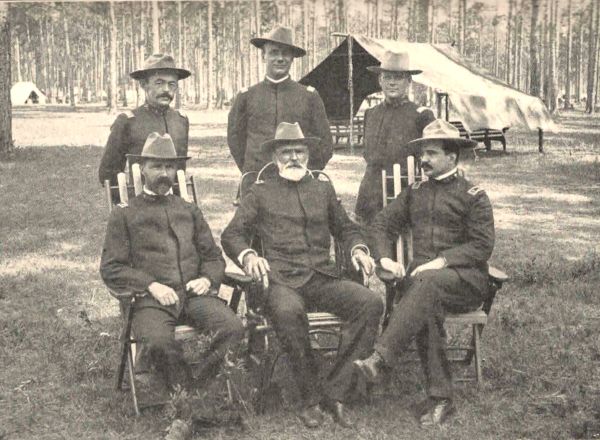
Brig. Gen. John C. Bates and staff. Bates commanded the Independent
Brigade in Cuba.
Please Visit our Home
Page to learn more about the Spanish American War
General:
The Independent Brigade, under the command of Brig. Gen. John C.
Bates, consisted of the 3rd U.S. Infantry and the 20th U.S. Infantry.
These regiments were part of the IV Army Corps, but were assigned to Major General Shafter's Vth
Army Corps. Therefore these were the only troops of the IV Army
Corps to served in Cuba during the war.
The following account of the Brigade's service was written by Henry E.
Wilkins who served as a major in the organization.
Unit History:
Bates' Independent Brigade was organized at Mobile, Alabama, about May
15, 1898. The personnel and organizations were as follows:
Brigadier General John C. Bates, U. S. V. (Colonel 2nd
Infantry).
Lt. Wm. M. Wright, 2nd Infantry, A. D. C.
Lt. Harry E. Wilkins, 2nd Infantry,
A. D. C., Acting
Quartermaster and Commissary.
Major John A. Logan, Jr., Adjutant General, U. S. V.
Major D. M. Appel, M. C., Brigade Surgeon.
Lt. Samuel E. Smiley, 15th Infantry, Ordnance Officer.
Major Frank J. Ives, M. C., afterward became Brigade Surgeon.
3rd Infantry, Col. John H. Page, Commanding.
20th Infantry, Major W. S. McCaskey, Commanding.
Squadron 2nd Cavalry, Major Wm. A. Rafferty, Commanding.
(These were the only mounted troops with the Santiago expedition).
Shortly after the first of June, the brigade sailed from Mobile in several
vessels, hastily and illy fitted for the transportation of men and
animals. This was to have been expected, as it was the first time any
troops had been transported by sea for a hostile purpose, since the Civil
War.
Brigade Headquarters were on the S. S. Matteawan [Transport
MATTEAWAN] In the light of
present day sanitation, most of the troops, and especially Brigade
Headquarters, should have died from typhoid, para-typhoid and typhus
fever. Headquarters messed and slept in the cabin.
Upon arriving at Tampa, the animals were unloaded pending the sailing of
the 5th Corps for Cuba.
Fortunately the officers and men retained their quarters on the vessels,
so when orders were issued for the re-embarkation, so far as Bates'
Brigade was concerned, there was no unseemly scramble for transportation.
As is well known, the expedition sailed from Tampa Bay June 14, and
arrived in the vicinity of Santiago, June 20. The Brigade followed Lawton's
2nd Division in landing at Daiquiri
on June 22, bivouacking on the beach that night.
Upon landing, we were met by those hardy spirits found in all commands,
who had scaled the hill on which a block house was located. Their sole
booty was a demijohn of vin du pays, which tasted no worse than our more
recent acquaintance, vin rouge. The next day the brigade marched toward
Siboney, camping that night along a water pipe line that had supplied the
residents and industries at Siboney and other villages on the railroad,
from the iron mines to Santiago Harbor.
On the morning of the 24th, the brigade reached Siboney. General Bates was
placed in command at that point. The troops assisted in unloading vessels,
repairing roads to the front, and making reconnaisances along the railroad
leading to Santiago. On June 24, the wounded from Las
Guasimas field began to filter down to the beach and were cared for
as far as hospital facilities permitted. About 8:30 P. M., on June 30, the
march to General Shafter's
headquarters began. We marched till midnight, bivouacking near
General Wheeler's headquarters. Camp was broken about 6:30 in the
morning of July 1. General Shafter's
headquarters were reached in due time and the column halted. About 10:00
A. M., we began our march to El Caney, where the troops were eventually
put into the line between Chaffee's and Miles' brigades. On our way to the
front we met Colonel Patterson, 22nd Infantry,
who had been wounded early in the attack.
The brigade joined in the assault and capture of the stone fort. While
firing upon the village after the capture of the stone fort, Capt. John B.
Rodman, 20th Infantry, was wounded. At the conclusion of the engagement,
General Bates withdrew his command, and after halting it at the first
stream, proceeded with his staff to General
Shafter's headquarters, where he received orders to
march his troops to San Juan Hill and form on the left of Pearson's
brigade.
This movement was completed by midnight, July 1st, and on the morning of
July 2nd, we were agreeably surprised to find our position was to be on
the left of the 2nd Infantry,
which General Bates, Wright and myself had last seen on May 11th, when we
left it at Chickamauga Park. The 20th Infantry was placed on the left of
the 2nd and the 3rd Infantry
on the left of the 20th. The position was consolidated and extended in the
next few days. The Seventh Massachusetts reported about July 6, and was
placed on the left of the 3rd Infantry.
Firing on both sides without an advance by either was had on July 2nd and
3rd, after which hostilities practically ceased. Captain C. W. Rowell, 2nd
Infantry, was killed by a shell on July 2nd.
In the attack on El Caney, three men were killed, Captain John B. Rodman,
20th Infantry, and ten men wounded. On July 2nd and 3rd, one man was
killed, Capt. H. B. Moon, 20th Infantry, and seventeen men wounded. These
were all the casualties due to action in the brigade from July 1st to July
17th, on which day Santiago de Cuba surrendered. The casualties in General Shafter's command, while very
great, considering the comparatively few men in the trenches opposing us,
would have been much greater but for the fact that the Spaniards fired at
a fixed high elevation. This was a source of much gratification to the
writer subsequently, for while we were marching by the flank in rear of
the 25th Infantry, the sound of bullets striking the branches overhead,
with the leaves and branches falling on us, convinced me that with a lower
elevation someone else, perhaps, might have been writing this brief
report.
On July 4th, while on my way to the subsistence dump, I noticed that the
branches and trees had been cut off about eight or nine feet above the
ground by bullets fired on July 1st, by the enemy. Had the elevation been
five feet lower, it would have been fatal to many more of our men.
Because of his expert marksmanship, Lt. C. H. Muir, Adjutant 2nd Infantry (later Major General U. S.
A.), completely silenced one of the dangerous heavy guns of the enemy.
Bates' Brigade did not suffer from lack of subsistence. On leaving
Siboney, five wagons of subsistence were taken with us. These wagons were
parked near General Shafter's
headquarters when the brigade went to El Caney. On our return, they were
taken to San Juan Hill, the rations dumped on the reverse slope of the
hill, and the wagons sent to the rear. The brigade quartermaster guarded
the rations till morning. Additional rations were obtained July 4th, and
afterward as needed.
The writer remembers meeting while enroute to San Juan Hill on the night
of July 1, Lieutenants Pershing, Farnsworth, Hersey and McAlexander, who
were also quartermasters of various other units on the field, Lt. John L.
Hines, who was quartermaster 2nd
Infantry, Omar Bundy, of the 3rd Infantry; F. R.
Day, of the 20th Infantry, and M. E. Hanna, of the 2nd Cavalry Squadron.
In passing, it is well to state that the five ambulances first available
were brought, two each, by the 3rd and 20th Infantry, and one by the
squadron 2nd Cavalry, from Mobile. The buck board used by General Shafter, after he
landed, was a part of the equipment of the 3rd Infantry, brought
originally from Fort Snelling.
General Bates' Brigade, with additional troops, was organized later as a
Provisional Division, and in due course, sent to Montauk Point. I left the
command sick on July 8th, and did not have the pleasure of again serving
directly under General John C. Bates.
Bibliography:
The Santiago Campaign. (Richmond, VA: Williams Printing
Company, 1927) 53-57.
Support this Site by
Visiting the Website Store! (help us
defray costs!)
We are providing
the following service for our readers. If you are interested in
books, videos, CD's etc. related to the Spanish American War, simply
type in "Spanish American War" (or whatever you are interested in)
as the keyword and click on "go" to get a list of titles available
through Amazon.com.
Visit Main Page
for copyright data