Arron W. Neyhouse's Account
of serving with the
17th U.S. Infantry, Co. F
Contributed by Jeff Neyhouse (great-grandson of
Arron Neyhouse)
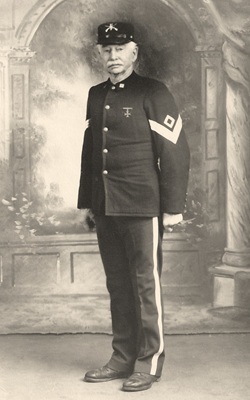
Arron W. Neyhouse in his Spanish American War uniform
at age 80
Click here for
the El Caney Battle Report of the 17th U.S. Infantry
Click
here for the Journal of Charles Taylor of the 17th U.S.
Infantry, Co. F
Click here
for the Biography of Capt. Charles St. John Chubb, of the 17th U.S.
Infantry, Co. F
General:
Below are the remembrances of Arron Willard Neyhouse who served in the
17th U.S. Infantry, Co. F as recorded in a series of ten articles in the
Batesville Guard newspaper that appeared between January and
April, 1952.
Arron Neyhouse was born near Chandler, Indiana on June 8, 1872, the
son of Arend Neyhouse and Eliza Jeffcoat Neyhouse. At the age fifteen,
following a disagreement with his father, Arron left home. For a year he
worked on a dairy farm in the adjoining county. Following this he went
to Evansville to look for work and met some soldiers there. He enlisted,
lying about his age since he did not have his parents' consent
(something that was seldom possible during the Spanish American War
period. Following his enlistment, he was sent Columbus Barracks at
Columbus, Ohio. This was followed by Fort Russel in Wyoming. It was here
that he was assigned to Company F of the 17th U.S. Infantry. He implies
he was present at the Battle of Wounded Knee, though he is his
account has some inaccuracies that call his presence into question (he
combines it with the death Sitting Bull which occurred in a completely
different time and location).
Following the completion of his period of enlistment, and then
returned to Purdue University finishing his freshman and sophomore
years. Unfortunately he had to drop out at that point for lack of money.
Neyhousee re-enlisted at the age of twenty-three and managed to get back
into the same regiment and company.
After the Spanish American War he moved back to Indiana and married
Emma Anna Wiggers, became a minister in the Methodist Church and also a
farmer. He also ran for political office. Because of the cost of land,
bad weather, etc., they eventually moved to Arkansas.
With the passing of his first wife in 1941, Neyhouse remarried
Christena Zacarias. She passed away in 1951. Neyhouse eventually
remarried again, this time to Envil E. Stokes, who passed away in 1958.
The marriages produced four children - two daughters, Juanita Darby, and
Wilma Rowe, and also two sons Elmer Alvin Neyhouse and W. J. Neyhouse.
Arron Neyhouse died on May 9, 1962. He is buried at Liberty Cemetery,
Sulphur Rock, Independence County, Arkansas
The reader must keep in mind that Neyhouse does speak of things he did
not see or necessarily see enough of to fully understand what was
happening during certain events. For instance, his account of what was
really the rather confused action at Las Guasimas speaks of seeing
charges and counter-charges. In fact even the participants involved
could not clearly see what was actually occurring in the dense
undergrowth. He comments that the American cavalry seemed unarmed as
they did not have cavalry sabers, etc, using only carbines. In fact the
cavalry was fighting as dismounted cavalry and sabers would have been of
no use. In fact, the Rough Riders, for
instance, were using the same Krag rifles as did the Neyhouse' own 17th
U.S. Infantry. He also reports that the Spanish line broke. In fact, the
Spanish troops were merely fighting a rearguard action and did not
break, but merely withdrew as was their role. Sgt. Neyhouse's
understanding of these actions were likely influenced by later accounts
which were used to fill in the gaps of he could not actually observe.
This is very typical of veterans' account of any action. One man can
only see what actually occurs in front of them. Later they will try to
understand what they saw as part of the larger action, usually
simplifying those actions. The modern historian, of course, simply needs
to be aware of this issue when reading the remembrances.
One additional note on Arron Neyhouse. Various documents spell his
first name differently - Aaron, Aron or Arron. This document went
with Arron as that was the version that his son listed on the
document requested a government headstone
The Account of Arron Willard Neyhouse, 17th U.S.
Infantry, Co. F
I reenlisted in the service on January 14, 1896, at age 23, after
completing my first enlistment (12/10/1888 – 3/9/1892), followed by two
years at Perdue University. I entered back into the U.S. Army 17th
Infantry Regiment in my same company (Company F). Nothing of
interest happened outside of the rifle practice one summer at Cleveland
and one summer at Fort Knox, Ky.
A Time of Great Awakening
But on February 15, 1898, a great catastrophe took place. The Battleship
Maine was blown up in Havana harbor. Two hundred and sixty men and
officers went down with the Maine. A great wave
of wrath swept over the United States. People said everywhere "Remember
the Maine” It was a time of great awakening in the U.S. The Cubans had
started a revolution some two years before. They had been under Spanish
domination and rule since their discovery by Columbus more than 100 years
before, and their despotic and cruel rule made living in Cuba virtual
slavery. Many of the Cubans had been gathered in great concentration camps
and many died of cruelty and disease.
War was eventually declared by President McKinley's
Congress on April 26, 1898, and immediately troops that had been under
marching order for weeks began to move to great drill camps. Our regiment
got its order to move south on April 26. All companies assembled in their
respective company parades and the first Sgts. [sergeants] made their
reports to their company commander: "Sir, company .......is present or
accounted for." The company commanders returned the first Sgts. Salute:
"Take you[r] posts, sir."
Battalion Formation
Each company took its place on the battalion parade ground, there being
three battalions of four companies each. We marched out of the barracks
with the regimental band leading and playing "There'll Be a Hot Time In
the Old Town Tonight." Later on the band took up “The Girl I Left Behind."
Then again, "There'll Be a Hot Time In The Old Town Tonight." No matter
how tired we were it always pepped us up.
We entrained in three sections, as each battalion made up one train. We
went south through Cincinnati, Nashville, Birmingham and Thomasville,
Georgia, and on through northern Florida. We crossed a dreary stretch of
country as we crossed [the] Suwannee River that is so famous in song. It
was lonely and dreary through the low land with no house or anything of a
civilized nature to see. We reached our journey's end at Tampa, Florida,
which was a military encampment, after weeks of training we were able to
take ships for Santiago, De Cuba.
We fared very well on our trip south. Each meal was the same: corned
[bread], canned beans, canned tomatoes and hard tack. The mess offer
telephoned ahead and always had plenty of hot coffee for each of the three
meals a day. I think we were about three days making the trip. I was
surely glad when we unloaded at Tampa and marched about two miles north of
town to our campsite. We had some sand fleas, but they weren't too bad. We
went bathing in Hillsborough River but soon quit as one of the boys nearly
got chewed up by some alligators. The land was a sandy waste covered
mostly with dwarf palms. We could have made fortunes if we had bought a
few acres and held them for a few years, as land values went sky-high
after we left.
If I Ever Get Off
We took ships for Santiago De Cuba on June 16. My company of the 17th and
another company went aboard a small gulf steamer named "Manito"
{MANTEO]. It being small and light made most of the boys terribly
sick as we went along north of Cuba. When we
struck the east coast and windward passage, I thought our time was near,
for no one could stand on the deck as the little ship rolled and pitched.
I thought every minute would be our last. After being aboard for a few
hours, I saw the boys beginning to get sick. Some of them were saying, "Oh
Lord I'm so sick. If I ever get off this boat, I'll never get on another."
So I took one of my blankets and tied a stout twine to each corner and
found two steam pipes that looked strong. I tied the twine to pipes, each
about three or four feet apart. By getting on a stool, I could climb in my
blanket, which hung about three feet from the ceiling, and I had a nice
place to lie. The heaving and rolling of the ship did not bother me very
much, and I wasn't sick at any time during our voyage.
Gunboats Shell Seashore
When we got on the south end of Cuba,
offshore from Santiago, we didn't land immediately, but stood off several
miles while the gunboats shelled every part of the shore that looked as if
it would hide an enemy. But as far as I could learn, they failed to find
any sign of hidden batteries of the enemy.
Our ship stood off coast about ten or twelve miles until we were signaled
to sail in. No enemy was in sight as we came toward the shore. We passed
the mighty "Indiana", which was one of the
largest battle ships of that day, and it looked like a monster of
destruction. The "Oregon" had left San Francisco
harbor sometime before and was making its way through 14,000 miles of
ocean water so it could be on hand when it was needed.
Hobson's Failure
The Spanish fleet was in Santiago harbor ready to come out and destroy
the army of invasion, which was only a few miles away waiting on transport
to gain the all-clear signal. An attempt had been made by Lt.
[Richmond] Hobson and a detail of sailors to block the narrow inlet
which connected the Caribbean Sea with the harbor. But Hobson failed to
block the harbor, as the [collier U.S.S.
Merrimac] which he used and blew up drifted around lengthways
instead of crossways. Hobson and
his men were captured and placed in Moore [Morro] castle on the seashore
of the harbor.
We were out in the Caribbean waiting our turn to go shoreward and to
land. Some of the boys, while they were waiting, dropped a large rope
along the side of the ship and went swimming. One time was enough. We had
to hold to the rope or the tide would carry us away. We were having a big
time when one of the boys on board yelled, "Look out for that shark!" The
shark was coming in to seize one of the boys, but we, about 15 or 20 of
us, made so much noise and splashed so much water that the shark turned
just before he got to the nearest soldier. We all got aboard safely and
took no more baths in the Caribbean.
Signal to Come Ashore
We got our signal to come as near shore as possible about noon, and we
immediately began to unload into small boats that took us the short
distance to the shore. Our boats shoved up against an old dock with 10-by
10 sleepers held up by 10-by 10 piles. These 10-by 10 sleepers were about
ten feet apart. All of the planking had been removed, so we had to climb
up or be pushed up on those sleepers and walk them to shore, which was
about 50 yards off. About every ten feet there was a cross sleeper, of the
same size as the ones which extended shoreward. They were boxed together
at the intersections. There were no planks to walk on.
Each soldier had a cartridge belt with a hundred cartridges for his
rifle, the .30-.40 Krag-Jorgensen. The army had, a
few years before, discarded the old Springfield
black powder .45-.70 single shot rifle for the .30-.40 Krag-Jorgensen, which were more high-powered
and used smokeless powder. These rifles [w]ere far superior to the old Springfield. The old Springfield was very
accurate rifle up to 800 or 1,000 yards but it kicked like a mule and made
your shoulder black and blue and knocked your nose half off if you didn't
hold it good and tight. That Krag
was also an accurate rifle. There was no smoke when you fired and very
little kick. Besides, you had a magazine that held five cartridges with
one in the chamber, making six in all. When fully loaded, you also had a
cut-off on the magazine and could use the rifle as single shot rifle.
Besides the cartridge belt filled with 100 cartridges and holding our
sword-bayonet, each man carried a blanket roll containing extra
underclothes, socks, etc. We had our haversacks filled with rations enough
to last for several day[s].
I was pushed up on one of those sleepers and started to walk it to shore.
I had no more than started when the ocean motion got me and I started to
run. Luckily for me, the colonel was standing at the first intersection
and as I came running up, he grabbed me, shook me, and told me to stop
running. I did so and made it to shore without further trouble. I said to
myself I was glad the colonel was there to stop me, otherwise I might have
fallen off the sleeper into the water which looked to be about 10 or 12
feet deep. I would probably have been drowned. The colonel had said "Get
that sea motion out of your head and walk ashore like a soldier".
Our regiment of 12 companies assembled as we came ashore, and we marched
inland some two or three miles to camp beside a small creek of clear
running water. Sgt. Gunn and I started a small fire and made our first
meal in Cuba by putting on a
pot of beans with a piece of bacon for seasoning, frying some bacon, and
making coffee in a half-gallon bucket. With our hard tack we soon had a
meal which we enjoyed very much, after being aboard ship so long without a
cooked meal.
After supper Sgt. Gunn and I went downstream to take a bath and wash such
clothes as needed, using a rough rock for a washboard. Coming back, we
raised our dog tent by buttoning each man's half together and pegging it
down. When properly raised it made a very good shelter for two men. It
might be well to mention here that our regiment belonged to the Third
Brigade which as I remember was composed of the 17th Regular Infantry
[17th U.S. Infantry], the 12th Regular Infantry [12th U.S. Infantry] and
the 2nd Massachusetts Volunteer Infantry.
The brigade was commanded by [Brig.] General Adna R. Chaffee.
Cavalry Takes Lead
On the day we broke camp, the First Cavalry brigade took the lead. This
brigade was commanded by General Joe Wheller and consisted of the First
Regular Cavalry, the 10th Negro Cavalry, and the First Volunteer Cavalry
known as the "Rough Riders." They were to comb the front and flanks for
any enemy that might be lying in ambush and to be on the lookout for enemy
scouting parties.
The First Cavalry Brigade someway ran into an ambuscade and hard fighting
took place [Battle of Las Guasimas]. The Third Brigade of infantry was
following after the Cavalry. Company F was leading the 17th Regiment. We
had built our fires and were cooking dinner, for it was near the noon hour
and we were tired and hungry. Our coffee and bacon were ready, and the
beans were only half done. But we were not to enjoy our good meal.
Fall In, Company "F" !
Our attention was directed to a staff officer running to each
company headquarters. Almost immediately our company commander and first
sergeant called out "Company F fall in, Company F fall in!" We grabbed
up our coffee and bacon and dumped out our half-cooked beans, for our
captain explained that we were to march to the assistance of the Cavalry
brigade [Cavalry Division] under [Maj.] Gen. Joe
Wheeler which had been ambushed. We swung into line, and, looking
back, could see the other companies following as rapidly as possible.
I usually marched near the head of the company and on this day, after
nearly a mile of marching, I found myself and a lieutenant of the
company far ahead of the rest of the men. I was determined to be at the
battle and to hurry to the battlefield and help the hard-pushed,
ambushed cavalry. We were still in our wool uniforms, so by the time we
reached the field, we had sweated so much that we didn't have a dry
thread on us. We soon came to the battle scene and saw the Rough
Riders [1st U.S. Volunteer Cavalry] and the 10th
[U.S.] Cavalry in a line facing some Spanish companies. The
lieutenant and myself made our way toward a group of officers who were
preparing to lead a countercharge. We were intending to make our report
that reinforcements of the 3rd Brigade were near at hand.
We saw one very excited officer, who was small, had a gray chin beard
[and] was older than the others. He waved a long sword and gave at once
the command: "Forward to the Charge-- Ho!"
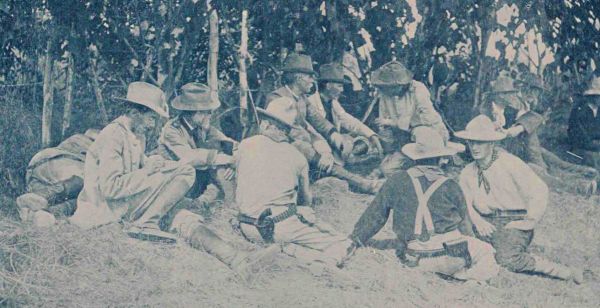 The conference held by Maj. Gen Joseph Wheeler and the
Rough Riders after the Battle of Las Guasimas. Laying down at left is
reporter Richard Harding Davis. Third from the left is Maj. Gen.
Wheeler. Next to Wheeler is Colonel Wood, who commanded the Rough
Riders at this time (back to the camera with the pistol on his hip).
Seated above Wood is Maj. General Lawton. Lt. Col. Theodore Roosevelt
is seated beside Wood in the dark shirt with the light suspenders.
The conference held by Maj. Gen Joseph Wheeler and the
Rough Riders after the Battle of Las Guasimas. Laying down at left is
reporter Richard Harding Davis. Third from the left is Maj. Gen.
Wheeler. Next to Wheeler is Colonel Wood, who commanded the Rough
Riders at this time (back to the camera with the pistol on his hip).
Seated above Wood is Maj. General Lawton. Lt. Col. Theodore Roosevelt
is seated beside Wood in the dark shirt with the light suspenders.
I Saw Teddy
The two regiments immediately took up double time and ran toward the
enemy, the other regiment being held for support. I saw Colonel
Teddy [Theodore] Roosevelt out in front of the Rough
Riders, holding a sword high in the air, his gray campaign hat
on its point. He was pointing toward the Spanish with his other hand, and
he repeated Gen. Wheeler's
command. Such yelling! I have never heard as much noise as both companies
were making.
It seemed as though the Spaniards had made a charge at about the same
time, but when they saw our men coming - and some of them black men - they
wouldn't or couldn't charge any further and eventually broke ranks as our
men got near the Spanish line.
It was a master bluff, for our men had nothing but their carbines to
charge with. I saw no enlisted men with cavalry swords, nothing but their
carbines, with no bayonets to fit them. All the Spanish soldiers were
infantry, and it seemed to me that each had a bayonet on the end of his
rifle. Nevertheless, they lacked nerve or courage to stand up to our men
in a hand-to-hand fight. Our men only ran a short distance farther and
stopped. They gave a mighty yell of victory as the Spanish disappeared
over the hilltop.
Wheeler Yells
I was trying to see everything I could, both out in front and what was
near me. I could not help but watch the little, gray-bearded officer who
was Gen. Joe Wheeler. He was excited and
jumping up and down, waving his long sword and yelling, "Give 'em hell
boys," and the old rebel yell, "Yipee Yee, Yipee Yee, Yip, Yee, Give the
Yanks hell, boys, give 'em hell." I suppose in Gen. Wheeler's excitement
he was carried back to the days when he was a famous Confederate cavalry
general and fighting the Yanks.
We could take our hats off to Gen. Joe Wheeler
and his cavalry brigade, for they had the battle won before even the
first relief regiments arrived. This was the first battle of the war
[actually the Battle of Cuzco Well had already occurred previously on
June 13 - editor's note] and was fought on June 23. It was known as the
Battle of Las Guasimas. As the 17th regular regiment took the point and
marched across the battlefield toward the front, we saw a long line of
men lying side by side. They were the dead that the hospital corps had
found. Each man had a blanket spread over him, and it looked like there
was quite a large number of men who had given their lives to make
victory possible. I heard that Hamilton Fish of New York was among the
dead. I also heard that Captain Capron's son was dead. This was bad luck
for the Spanish, as you find later on.
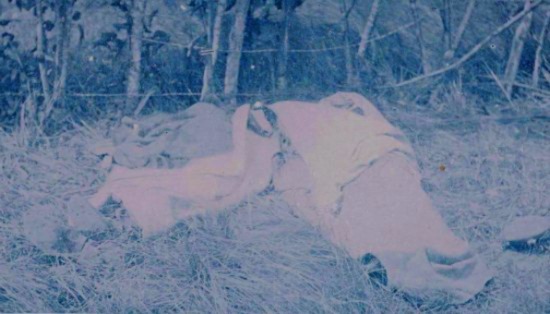
The bodies of Hamilton Fish and Pvt. Stevens, covered
with blankets, taken very shortly after the Battle of Las Guasimas.
This photo was taken only a few feet away from the conference pictured
above
Council Of War
Cubans brought information that a Spanish army of 9,000 men under Gen.
Panda was in our rear, in addition to the army in front of us that was
equal in number to our own size. So, our generals held a council of war,
for we were in a dangerous position. The majority of the generals voted to
move forward and attack with all our power the Spanish army in front of us
around Santiago. At this council it was also decided to send a message to
the Cuban generals Garcia and Gomez, asking them
to place their army between our army and Gen. Panda's to keep him from
attacking us while we fought at Santiago. It seems that this famous
message accomplished its aim, for we were not molested at any time from
the rear. Let me say at this point that the Spanish soldiers had the
advantage in having light cotton uniform with narrow white and blue
stripes running up and down their trousers and coasts. Most of them wore
light straw hats. They were armed with Mauser
high-powered rifles which were equal to our rifles. We wore heavy
wool blue uniforms that were entirely unsuited for a warm climate.
Constantly On Alert
The 17th regular regiment remained at the point during the next week and
until the big battle at El Caney and San Juan Hill, which took place on
July 1. We marched slowly and carefully during those days, being
constantly on the alert and making 12 miles a day. Our meals were always
the same: coffee, fried bacon, beans and hard-tack. (The hard-tacks were
about three inches square and ¼-inch thick. They were very good eating
when soaked in coffee - about the only way we could eat them. After they
were soaked, they swelled to about four inches square and ¾-inch thick).
But making coffee was a big job in itself, as the coffee issued was
Arbuckle whole glazed grain coffee. How were we able to make coffee
without a coffee mill? There was not one in the whole regiment. Sergeant
Gunn, my tent mate, and I soon figured out a way. We poured a handful of
coffee into one of our heavy quart cups and took the handle end of our
bayonet and beat the coffee grains into pieces. After boiling it for 1/
4-hour, we had very good coffee.
After supper and before sundown each company of the battalion and regiment
composing the point put out picket posts. Ours were at the extreme point.
Our picket posts, known as the Cossack picket posts, were composed of
three privates and a non-commissioned offer. These posts were from two to
three hundred yards apart, and formed a chain in front, on each flank and
on the rear of the army completely - surrounding it. The posts were
stations in secluded places where they could watch the approach of the
enemy without being seen.
Experience On Post
I remember one rather humorous post duty experience. I had for my Cossack
picket private Legg, Dague and Monroe. I believe our watch was from one to
four o'clock. Each man was to watch one hour in his turn. I placed a man
on watch out in front and told him to lie down in some grass and sagebrush
and to rise up on his knees every minute or so to observe everything in
sight. The two other privates and I dropped back 25 to 30 yards and
hunkered down in the grass and sagebrush. We kept wide awake and, on the
alert, observing anything that was within our sight. It so happened that
the moon was almost full, and we could see very distinctly for quite a
distance. It was while Private Legg was out front on watch that the
disturbance occurred. We heard a rustling noise quite a way out in front
in the grass. The noise was coming toward us and getting louder as it
came. We all raised up on our knees to see better what it might be. At
once Private Legg yelled out: "Halt, Who comes there?" Still no answer. I
could tell by the noise that it was almost upon Legg. This time he yelled
out with all his might: "Halt, Who comes there?" No sooner had the words
left his mouth than there was a might bur-r-r of wings. A flock of 25 or
30 wild guineas had just risen and were flying over us. It was frightening
at the time, but afterwards we laughed about.
March Continues
We continued our forward march to meet the enemy. We contacted them
on the afternoon of [J]une 30. Our scouts reported the enemy in force at
El Caney and San Juan Hill [what follows is an account of the Battle
of El Caney - editor's note]. On that night we were not allowed to make
any fires, as the enemy was only a few miles in advance of us. We camped
that night without raising any tents, and slept without fighting arms at
our sides. At day light each company and regiment was awakened as quietly
as possible and told to assemble and continue the march as on the previous
day. After marching a mile or two we could hear the reports of the rifles
of our skirmishers and could also hear the reports of other rifles which
we knew belonged to our enemy, since they made sounds different from ours.
As we marched along I ate a light breakfast of raw bacon and hard tack.
After 8, marching for a short distance, our company, being in front, ran
up against a high barbed wire fence. This fence was parallel with the
road, which was worn out about three feet deep, and was on the shoulder
toward the enemy. I counted 12 barbed wire heights and a post every 10 to
12 feet.
I noticed that the fence had been cut at this point ... no doubt, to let
some of our skirmishers through. What attracted me most was that wounded
men were being carried through the gap. While our march was checked for a
few minutes, I saw some of the men carry out Colonel Haskell, Lieutenant
Dickenson, Lieutenant Mickey [Michie] and several others who had been
wounded. We were ordered to march by the right flank down the worn out
road. This we did until we were told to halt and lie down.
Block Houses and Wire
It was then that I noticed several block houses and long lines of stone
fence in the distance. The barbed wire fence along the shoulder of the
road we were traveling was about six feet high and was intended to halt
our advance but it did not stop us for long. As soon as we halted, men
with wire cutters from each company crawled out and began to cut the wire
between the posts. A few of the men were wounded by enemy fire, for while
they were cutting the wire, the volume of the enemy shooting increased
rapidly as we took our positions in their front. The grass and weeds were
thick on each shoulder of the old road. We could look through the weeds
and grass, but there was nothing for us to shoot at but the block houses
and walls of the rock fence. No enemy was in sight. On top of the largest
block house was a flag of red and yellow stripes. Our colors were waving
from their staff which was planted on the shoulder of the road next to the
enemy. We lay all morning with very little firing from our side. I could
see down in the valley and I could hear spasmodic firing and I could see
the smoke from their rifle fire. I knew at once that the firing was from
our volunteer regiments as most of the volunteers were armed with the old single shot Spring-field rifles which we had
discarded a few years before for the high-powered Krag
Jorgenson rifles. When the old single shot Springfields were fired
they threw up a fog of smoke like a brush heap on fire. They soon had to
cease firing, as the Spaniards riddled their firing points and wounded
many men. We had a great advance in firearms over the volunteers, for the
Krag rifles when fired showed only a light misty smoke that soon
disappeared.
Casualties From Flank Fire
We began to have casualties before noon. The peculiar thing about the
rifle fire which caused our losses was that the firing was not from the
front, as we were well-protected in front by the shoulder of the road. But
our losses were caused by firing from the right flank directly up the old
road.
It was then that we first noticed a blockhouse directly to our right and
commanding the old road. It was several hundred yards to our right and
could hardly be seen because of trees and brush, but it was causing our
losses in killed and wounded. The old road was a trap and we had blundered
into it and were caught. I wondered why our scouts had not reported this
blockhouse in time for us to avoid the trap. We were right where the enemy
wanted us, and they were making use of their advantage.
The bullets were beginning to tear the ground around me where I was lying.
Talk about getting scared, I was beginning to get scared! The more bullets
that tore up the ground the more scared I got. I wanted in the worst way
to be in a safer place. It took a mighty effort in will-power to keep my
legs from carrying me away.
Men were lying in this roadway about every three feet apart. I noticed
these men were staying in their positions and that helped to give me
courage to stay in my place even though bullets were tearing up the ground
a few inches from my head and between me and the man on my right and the
man on my left.
Talking To The Lord
It was then that I began talking to the Lord. I told him that I had five
girls at Columbus when I left here, but I would give all of them up but
one if He would just protect me and keep me from this terrible danger. I
thought I was making a big sacrifice doing that. I told Him that I would
be mighty good boy the rest of my life.
I saw almost at once that my pleading with the Lord was almost pure
selfishness on my part. It was then that I gave up and I told the Lord if
he wanted to take my life it was all right with me. But in taking my life,
please let it be to save some boy's life was a better boy than I. It was
then that I said "Lord, Thy will not mine, be done." It was then that
peace and courage flooded my being.
I did not expect much help because I was pretty mean and had not paid much
attention to the Lord and His wishes. Almost as soon as I had given up and
ended my pleas with the Lord I heard a bullet strike near me on the left.
It was a different sound from the other bullets that struck the ground.
Looking to the left I saw what had caused the different sound. I saw at
once a little blue hole just back of Pvt. Smith's ear and just below his
hat band. It was the style at that time for a great many soldiers to wear
mustaches. Private Smith was twisting the end of his mustache with his
right thumb and forefinger. He died so suddenly that he did not remove his
hand from his mustache.
The bullets were still tearing up the ground on each side of me and ahead
of me. One bullet tore up the ground under me and tore a button off my
blouse. I heard Sgt. Henderson, the man on my right, groaning and
scratching and kicking the ground. I asked him if he was bad hit. He said,
"Yes, I think I am. The bullet went through my right shoulder and came out
at my left, and my legs are beginning to feel numb. I need help.” It must
have been this bullet that struck underneath me ... a reflex action or
something raised my whole body off the ground at least a foot. I knew if
these riflemen were not stopped my departure would soon be at hand. I knew
that Sgt. Henderson and some of the other boys needed help from the
hospital corps. By this time the bullets from the blockhouse were coming
over like a swarm of bees, and it seemed that I would certainly be hit if
I got up and went down the line after the hospital corps.
Pass The Word
So, I called out, "Pass the word down the line. Men badly wounded and need
help from the hospital corps." I heard the men repeating the message on
down the line until I could not hear the words any longer. Then an officer
called out just a short way down the line, "Whoever sent that message down
the line, I order him to get up and go down the line and deliver it
personally to the hospital corps." I did not go, but called out again,
"Men wounded up here and need help from the hospital corps." It was at
this time that the regimental commander lying not over ten feet from me
called out: "Lieutenant Bricker, call out six or eight sharp-shooters and
take care of that blockhouse that is causing us our trouble." The order
was followed and we were not troubled with any more firing from the
blockhouse. I heard afterwards from one of the men that they had killed
every Spaniard in the block-house. Up until that minute I did not know the
colonel was lying near me. He also called out to the officer who ordered
me to go down the line and report to the hospital corps in person. "It's
all right," he shouted. "I need the sergeant to cut down some weeds in
front of me with his bayonet so I can get a better view of the blockhouses
out in front.
It had not been over ten minutes, it seemed to me, since I had sent word
down the line for help from the hospital corps, when I saw the corps
coming with Major Eberts, a surgeon, in the lead. He was followed by men
carrying stretchers. They took care of our casualties in a short time,
paying no attention to the bullets which were flying like a swarm of bees.
At this time we were under very heavy firing [from] the blockhouses of the
Spanish soldiers. Many of the men were beginning to get restless -
especially those on the left flank. But along about three o'clock, a fire
from the enemy almost died down.
General Lawton Sings
It was then that I could hear someone singing. No doubt the singing was to
revive the courage of the fighting men. I heard someone say, "That's Gen. Lawton singing his famous battle song" He sang
in a strong, clear baritone voice, "I want to die a soldier on the
battlefield, and let my comrades carry me home upon my Spartan
shield”....I heard that Gen. Lawton had sung it on many battlefields.
Lawton had enlisted at
the age of 18 in the Indiana volunteers. He was made first sergeant of the
company and served through the Civil War. In 1865 he was mustered out as
Lieutenant Colonel of the Volunteers. He was recommissioned Second
Lieutenant in 1866 and served continually as an officer in the Army. At
this time he was a Major General in command of a division. I saw in a
paper some two years later that General Lawton had been killed while
leading his division and singing his famous battle song over in the
Philippine Islands.
Shortly after I heard Lawton's song, I saw a man crawl through the opening
in the barbed- wire fence where it had been cut. He got behind a tree that
forked near shoulder high and he began firing at the blockhouses. He was a
recruit of only about two months of service. I saw another man who was
officer walk over to where the recruit was behind the tree and say to him,
"What in hell are you doing here? Don't you know that you are liable to
get shot? Get back into the line where you belong!"
General Told Off
The recruit merely looked over his shoulder at the officer and said, "What
in hell are you doing out here officer? Don't you know that if you get
shot it would be a much greater loss to the Army than if I got shot? I’ll
tell you just like you told me - get back in the line! " The officer took
another good look at the Spanish blockhouses. Then I noticed both of them
crawling back into the line. The officer was General Chaffee in command of
the Third Brigade. The name of the recruit I did not know. There is no
telling what a recruit will do. We were surely getting tired of lying in
the old roadway and looking at the Spanish flag and blockhouses of the
enemy.
Our small arms fire had no effect whatsoever on the blockhouses of the
enemy. What we needed was our field artillery, and where was it? So far
during the battle I had not seen nor heard any artillery- either Spanish
or American. I knew that we had artillery because we had passed some
batteries the previous day. They had been doing their best to pull the
pieces of artillery up a hill, but were having poor success, as the roads
were mirey from the black mud caused by rain having fallen nearly every
day.
I was due for a surprise as I heard a crashing boom toward our rear. I
looked toward the Spanish blockhouse and saw where a shell from the light
artillery piece had stuck and exploded with a loud crash. I glanced back
to our rear and saw the smoke from his field piece and what looked like a
battery just getting into position on a flat piece of ground about one
mile to our rear. This was on higher ground than we were on, and I could
see the battery plainly.
It was then I heard the report and saw the smoke from the second piece.
The shell struck the ground and exploded 12 or 15 feet short of the
blockhouse. It was too low, but exploded with a loud crash and tore up the
ground leaving a big hole. The first shot was too high; the second too
low.
Battle of El Caney, July 1, 1898-Enemy Routed, Runs to Rear Like Deer
The first shot was too high, the second, too low. About that time the
third shot came over and struck the biggest blockhouse in the center,
tearing it to pieces. It was then that the third brigade woke up and came
to life - such cheering and yelling as they gave, I had never heard
before. The artillery now had the range. In less than one-half hour they
had torn all the blockhouses and block fence literally to pieces.
In some way we found that this was Captain Capron's battery and that he
was exacting a terrible price from the Spaniards for his son, who was
killed at the battle of Las Guasimas.
The Spaniards were coming out of their blockhouses and from their fences
and running to the rear like a deer.
During the bombardment, General Lawton had swung the left flank of the
division around toward the rear of the Spanish blockhouse to such a way as
to cut off the retreat of many of the Spaniards and capture them. As the
bombardment stopped, the command was given to the regiments - "Forward
Charge!". We swung forward at double time and in a few minutes we had
possession of all the Spanish works. Immediately we pulled down the
Spanish colors and hoisted our Stars and Stripes.
El Caney Battle Ends
After capturing all the Spaniards left behind, most of them wounded, we
were then ordered back to the lines which we had occupied during the day.
I heard Gen. Chaffee say, "Boys, fall out and hunt for the wounded, as
some of them will crawl off and hide. We surely don't want to leave any of
them behind who are wounded and would die if not found.
Most of the companies and regiments were assembled and marched to the rear
and back to the camping ground of the night before. We cooked a bountiful
supper, for we were as hungry as starved bears, not having a cooked meal
since noon the day before.
This battle was known as the battle of El Caney and was fought on July 1,
1898. We had finished our supper and most of us were getting ready to
pitch our dog tents and sleep.
It must have been near 7 o'clock when the order was passed along from
company to company to be ready to march in 15 minutes. We learned after we
were marching that the "Rough Riders" and other
troops engaged in the capture of San Juan Hill were meeting with little
success, and that we were badly need to reinforce them and help them in
holding this line of hills.
Rumors and Dry Runs
Twice we started out from El Caney, but retraced our steps when the scouts
reported that large numbers of the enemy were blocking roads. The third
time we went far to the left and it seemed like this time we were going to
have better success. As we marched slowly along the scouts kept reporting
back from time to time that there was no enemy, or at least they did not
contact any. We all believed at this time that we were going to get
through to help the hard-pressed troops who were trying to hold San Juan
Hill.
We marched along this road and at daylight we began to hear firing in
front of us, and along about sunup the firing increased considerably. We
knew that the firing was between our troops and the enemy. The Spaniards
were doing their best to drive our troops back and up the hill which we
were trying to hold until reinforcements could arrive.
The line of hills held by the enemy was strongly fortified, but the hills
that we were occupying and had seized the day before were not fortified.
The enemy was trying to drive our troops out before they had time to dig
in. But help was at hand.
Inexperienced Regiment Starts Panicked Retreat in Face of Spanish
Onslaught
A little after sunup when we were a little more than one-fourth a mile
from the line of hills held by our troops, we were met by men who were
running and yelling and waving their arms. They were yelling for us to go
back. They kept repeating, "Go back! They are coming! If you don't go back
you will be killed. The enemy is right behind us."
We were badly surprised, as well as confused, as we did not know what they
were running from. My Company F was in the lead of the regiment. We
halted, as we did not know what to think of these wild, running soldiers
who were going past us. I was near the head of F Company, which was the
forward point of the regiment, and we did not know what to do - neither
could we see the enemy following them.
Gen. Chaffee came trotting up from somewhere behind us, wanting to know
what the confusion was. He saw in a minute what he thought the trouble
was. He called out, "Fall out men, fall out on each side of the road and
lie down." That is what we did. Then Gen. Chaffee called out, "Who is in
command of this battalion?"
Come Out and Take Command
An officer quite a ways over in the bushes answered, "I am sir." "Then
come out here and take command, said Gen. Chaffee. He came through the
bushes looking very sheepish and like he would prefer being back in the
bushes.
The panic-stricken soldiers were coming in droves by now. I was lying on
the ground, about ten feet from the road watching the men running by. One
of these soldiers wearing glasses was running by near me.
I reached out and grabbed his leg, tripping him and throwing him down. The
breath was knocked out of him and I intended for him to lie down and stop
his running. I was curious and wanted to learn why they were running. I
crawled over and got astraddle of him in order to hold him down. He soon
began to struggle and try to get up. I told him to lie still and get some
sense into his head. If he did not I was going to knock some sense in his
head with the butt of my gun.
He looked at me and the gun and calmed down and lay still. I told him I
would let him up if he would stop running. I let him up and picked up his
glasses, which had been knocked off but were not damaged. "Now then," I
said. "Please tell me why you were breaking the speed limit running from
something that seemed to scare you so terribly. “
Using Black Powder
He said, "I will tell you about what started our panic. We belong to a New
York volunteer regiment [71st New York
Volunteer Infantry - there is no evidence of a mass exodus of the
71st New York from the battle line. In fanct, on this day the regment had
actually been pulled from the line for rest. The regiemnt had been heavily
engaged in the assault of the San Juan Ridge Line while the 17th U.S.
Infnatry was fighting at El Caney - editor's note] and were firing with
the old single shot black powder Springfield rifle.
The Spaniards were using smokeless powder Mauser
rifles and were killing and wounding many of the men who were using
the old-time black powdered rifles by firing into the smoke which was
caused by the firing of the black-powdered cartridges.
"This was the first time any of the boys were under rifle fire, and many
of us were scared half to death. One soldier was only slightly wounded and
badly scared and he jumped up and yelled; they are coming after us! I see
them! They are going to kill us all, so save yourselves"
"He started running and yelling. Other men began following him until whole
companies were running. We were scared and getting worse scared by the
minute and we intended to get away from there and away from what we
thought was coming after us.
"It was just about sunup, and a mist was between our lines and the enemy.
So we really thought the Spaniards were coming after us. We had had no
experience in fighting, and so the thought that was in every soldier's
mind was to save himself." I said to him, "You ought to be proud of one
thing - your ability to use your legs and keep the Spaniards from
capturing you." He said, "Mister, we did not intend for the Spaniards to
catch us if our legs could keep them from it."
Regulars To the Front
It was lucky our commander that we had another regiment. I was told that
it was the 13th regular regiment that immediately marched up and filled
the gap in the firing line left by these volunteers.
We marched to the right, parallel to the hills that were occupied by our
forces. We could see whole companies and some places there must have been
whole battalions of regiments lying just below the brow of the hill. They
had flags of distress attached to them. Others looked like the barrels
were sticking straight up in the air. I took that also to mean a signal
for help.
The young soldier that I had tripped was marching right by my side. He
said he wanted to stay with me for the day. The poor fellow had discarded
all his arms and equipment. He had also lost his hat, a most serious loss
in that hot climate. I told him to use a large handkerchief to protect his
head from the sun. He pulled out a blue handkerchief and tied it around
his head and wore it the rest of the day. Along about sundown, Capt. Chubb
advised this young man to go back where he had joined up and try to follow
up and find his company and regiment. He did so and that was the last time
I saw or heard of him.
Through Corn Field (The wording in this section has been recreated as
best as possible)
We marched about one mile to the right and then moved forward, taking up
our position on the brow of the hill, which was unoccupied at the time. My
company moved through a field of young corn about waist high in getting
out to our position. We went forward all hunched over through the corn.
The man on my right by the name of Hunt had joined up at Tampa. He said,
"Hold on a minute, Sarge." I did so and waited to see what he wanted. I
saw him pull out his bayonet and strike at something on my trouser leg. I
looked to see what he had knocked off and saw a giant tarantula lying on
the ground.
It was almost as large as my hand. He had cut off his legs close to his
body with the bayonet. He was trying to get back to me, but could not
crawl with his legs off. He was chewing his jaws and spitting green saliva
that looked very poisonous to me. I was certainly thankful to Hunt for
having seen the tarantula on my leg. He could have crawled up my back and
bitten me on the neck. We soon put an end to the tarantula by cutting him
up with our bayonets.
Spaniards Commit Biggest Blunder by Leaving Breastworks, Charging in Open
We spread out along the edge of the cornfield at the highest point along
the hill. We were told to dig in as quickly as possible, which we did
without any urging because enemy rifles were beginning to tear up the dirt
around us. We had no entrenching tools so we dropped down and began to dig
with our bayonets, using our quart cups to scoop the dirt toward the
front. In a very short time each man had a pile of dirt in front of him
and a hole to lie in. We were lying quite close to each other and were
told to dig out the side walls to form a long, continuous trench. We used
our crude tools to good effect and before sundown had a trench deep enough
to stand up in without being seen by the enemy. We knew now that we were
reasonably safe from the enemy's fire.
"Greater Love Hath---"
Back on our lines, some bushes formed a good observation point and I was
told to watch the enemy's line from there and report any movements they
might make. After the company had eaten dinner a good friend of mine named
Bobby Gray said he would relieve me and watch while I ate dinner. I was a
little slow in getting back, having gone by the creek to fill my canteen.
I was still at a distance from the OP when I saw them carrying a man back
from the lines. I asked who it was and was told that Gray had been killed
while on my watching post by an enemy sharpshooter and they were taking
him over behind the line to bury him. I was almost completely unnerved by
the news. I wandered around back of the line for several hours before I
could get the thought out of my mind that Gray had been killed in my place
and had I stayed at the post it would have been me being buried on that
lonely hillside. I could not get the scripture out of my mind -- "Greater
love hath no man than this, that a man lay down his life for a friend." I
knew Gray very well because he had slept on a bunk next to mine while we
were in the barracks. He had a song he would sometimes sing that went
something like this: "A bullfrog dresses in a soldier's clothes, shoulders
his gun and off he goes; Away he goes to fight a war, and comes back home
without a scar." He had told me that his father had fought with the
volunteers of Georgia and was in many battles of the Civil War. My own
father was in the Indiana Volunteers and no doubt they were on opposing
sides in some of the battles. But the sons of those old soldiers wearing
the blue and the grey were the best of friends and I would have given my
life to have saved his had the chance offered, as he saved mine. I suppose
Private Gray's body still lies in that lonely grave on the San Juan
hillside. After I got to the barracks of Columbus I sent his personal
belongings to his father in Hiram County, Ga.
The night our company was divided into two watches and I was to go on
guard duty at 12:00 mid-night, I had built a fire to dry my clothes and
cook something to eat and was lying back comfortably thinking of the good
sleep I would have when rifle fire broke out all along our front for three
or four miles. We heard someone yelling, "Night attack, you men off duty
behind the line head for the trenches." Amid the noise and confusion, I
jumped up, grabbed my shoes, clothes, cartridge belt and rifle and headed
for what I thought was the line of trenches. I believe this was the most
exciting time of my life. In the noise and confusion, I went too far to
the right and lost my sense of direction.
I kept going, thinking I would hit the trenches, but when I stopped to get
my bearings I found that I had gone around the brow of a hill and was 50
yards in front of my company's breastworks. In my hurry I had lost my hat,
but my biggest worry was where and how I was to get back to our trenches.
Enemy bullets were whistling and screaming and kicking up the dirt all
around me and I could see flashes from our rifles all along the line. I
made a foolish decision to get into our trenches from the front. I began
crawling toward a spot in our front lines where no flashes could be seen,
so I thought no men were there. I made a run for it and jumped over the
top of the trench, knowing that I was taking a tremendous risk. I landed
on something soft and yielding instead of the hard ground, and to my
surprise men began to yell, "we surrender," and "ouch, get off me." They
were holding up their hands and asking me not to kill them. I told them I
was not a Spaniard and that I would report them if they didn't get up and
start firing at the enemy. These seven or eight men proved to be some of
our latest recruits, and they told me they did not want to be killed.
These recruits were not the only ones who were scared during this battle,
as many of the older soldiers were uneasy too (if they would tell the
truth).
Eager Beavers
We were firing away at the enemy and doing all right when we heard a
tremendous noise and trampling of many feet behind us. It was our support
company which had jumped the gun and broken away from their officers. They
jumped our trenches and went on down the hill toward the enemy, with their
officers yelling, "halt, halt!" I happened to be near General Chaffee and
heard him call out, "What regiment was that jumping trenches?" Someone
told him it was the 22nd Infantry. I had heard a
great many men in this regiment complaining that they could not get into
the fight and bragging that they could lick the whole Spanish army
themselves. Almost immediately, Gen. Chaffee ordered us to cease firing
and with considerable difficulty prevailed upon our "F" Company bugler to
sound recall. Jakey Miller, one of the best buglers in the army but
somewhat scared at the moment, sounded the call from a kneeling position
next to Gen. Chaffee with four soldiers holding him to keep him in
position. The clear ringing tones of his bugle rang out piercing the night
air, reaching the ears of the headstrong 22nd
and bringing them back toward our lines. It is surprising how few men were
lost in this mad rush, and soon they were back to their proper support
position.
Counter-Attack
Now the Spaniards had left their breastworks and were charging us across
an open field. It was their biggest blunder. Terrific fire from our
trenches halted them and broke up their charge. Their losses were reported
to be very heavy as our scouting parties reported later that they were
removing their dead and wounded during the night.
As soon as daylight came I went out and found my hat, although enemy
sharpshooters spotted me and made life interesting while I searched. You
could hardly do without [a] hat without running the risk of sunstroke.
On the first or second day of July an incident occurred which was one of
the greatest importance to us. The 9th
Infantry spotted a group of officers riding along back of the
Spanish lines and a Sergeant McChesney asked permission to try and pick
off one riding a [white] horse. Permission was granted, and the
sharpshooter succeeded in bringing down the enemy officer at 1,400 yards
with his Krag 30-40. The badly wounded officer
turned out to be the commanding general of the Spanish army, Linares, an
aggressive fighter. His successor, Gen. Toral, was not so strong on
fighting and we had a much easier victory in the end because of this
luck[y] incident.
"We Have Met "
On the morning of July 3, we heard a tremendous firing from the direction
of the seas and before long we knew that one of the greatest naval battles
of all times was being fought between the Spanish and American fleets
[naval Battle of Santiago - editor's note].
About 2:00 p.m. the firing slackened and soon stopped entirely. Soon the
message came from the Navy Signal Corps" "We have met the enemy and they
are our[s] " We spent a good part of Monday, July 4, taking care of enemy
sharpshooters who had tied blankets up in trees to form positions where
they would like and fire at our men whenever they showed themselves. To
deal with them, we would send out three men, one to approach the tree from
the front and draw fire while two flankers got into position from either
side. This plan, though a bit uncomfortable for the front man, was very
effective. The peculiar thing about these men we shot out of trees was
that they did not look like the regular Spanish soldiers. Nearly every one
of them was light haired and blue eyed.
Armistice Called
About July 5, General Toral called for an armistice and
[Maj.] General Shafter, commanding general of our army, accepted. General Shafter was a big man, weighing
about 300 pounds. He was too heavy to ride a horse, so I saw him at
different times riding in an open buggy. We shifted our position to the
right, again dug good positions, and nothing of importance happened during
the next few days. We sent a flag of truce to inform the enemy that
fighting would be resumed on the 10th and that we would probably shell the
city of Santiago. Refugees were permitted to move out of the city and into
our lines, where we assumed responsibility for feeding them by dividing
our already short rations. Fierce fighting resumed and lasted through the
11th. On the morning of the 12th the Spanish commander again asked for an
armistice, and this time the firing ceased for good all along the line.
Peace--It's Wonderful
A few days later we were notified that the armistice was permanently
arranged and in due time terms of peace would be prepared between the two
countries. You can tell the world that news made us feel happy. About the
last week of August, we were again ordered to break camp. We marched to
Santiago and boarded a fine ship, the "Cherokee."
We left Santiago one evening and passed through the Windward Passage at
night, scarcely noticing the high waves which always make a very rough sea
on the east end of Cuba. We had a pleasant voyage and in a few days landed
at Montauk Point on the extreme eastern end
of Long Island. We debarked without incident and marched inland a short
distance where we pitched camp in a healthful area and settled down to
recuperate from fever and other ailments common to soldiers. After three
or four weeks our health was much improved and we entrained for our old
barracks at Columbus. We were well received by our old acquaintances there
and soon settled into the normal routine of a peacetime camp.
Once is Enough
I would not have missed my experiences in this war with Spain in Cuba for
a thousand dollars, but I would not want to go through those experiences
again. One thing that makes me feel proud of this experience is the fact
that I got to see some distinguished soldiers in action - -Colonel
Teddy Roosevelt leading his regiment of Rough
Riders at Las Guasimas and San Juan Hill; General Chaffee, one of
the finest officers to serve under and my own captain of Company "F",
Charles St. John Chubb. The last named treated me almost as if I were his
son. At the expiration of my enlistment, I took my discharge. I could have
reenlisted in my old rank of First Sergeant had I so desired, but I had
had enough of fighting in the tropics. Not long after I left, the regiment
was sent back to the Philippines.
To Arkansas
I left the Army and went back to where I had lived the first years of
my life – Chandler, Indiana. In less than one year I married one of the
finest girls I had ever met and we decided to 'try farm life.’ On
account of drought, bad crop years and heavy mortgages, we decided after
three years to sell and try some other location. We had some literature
from Arkansas that listed land at very low prices. I came to Batesville
and found a very good farm, hill land that could be built up, in the
locality known at that time as "Lickskillet", about 12 miles northeast
of town. I bought the land and had money enough left to buy a team,
stock and tools. I soon saw that I could not make a living just raising
cotton, so I changed to raising stock, having learned from good
authority that the "cow, sow, and hen" is a combination hard to beat. I
raised some cotton as the land became more fertile. We worked hard and
make a good living; we raised our family, had good and bad time[s], some
sorrow and plenty of happiness. We live in on one of the best
neighborhoods that could be found anywhere. I believed then and I still
believe that we made a good move when we came to Arkansas, which is
indeed as I see it, "The Land of Opportunity."
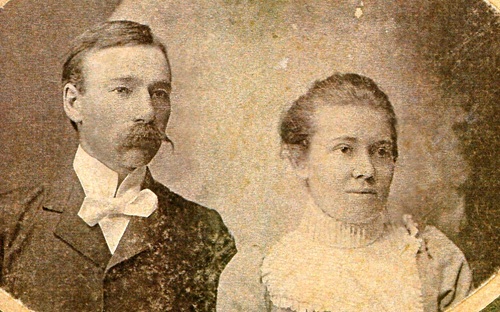
Aaron and Emma Neyhouse
in 1899. Emma Anna Wiggers (1878 - 1941) was his first wife. Aaron was
widowed three times.
Chamber of Commerce Note
I now live in the Allen's Chapel community, on the highway to Salado. It
is one of the most beautiful and desirable places that can be found
anywhere. The people are all good --we have no other kind--at least I
haven't met any other. It is so beautiful I can't understand why the
Garden of Eden couldn't have been located here or at some other spot along
White River instead of somewhere in Asia Minor or along the sandy wastes
of the Tigris or Euphrates.
Sometimes when we are not able to attend church we can sit on our porch at
twilight and hear those wonderful young voices singing in the evening
services at Allen's Chapel. At times, when the wind is right, I can hear
the words plainly and the one song I like best is "How Beautiful Heaven
Must Be." I am glad that I live near this live church where both young and
old are such wonderful singers and workers.
God and Mother nature have simply seemed to see how beautiful this lovely
valley could be made especially in summer. If you wish to see the most
beautiful and picturesque scene of all just stand some evening on the top
of Ramsey Mountain and look across White River as the twilight is coming
on, watch the shimmering of the water as it goes down over the dam, and
watch the lights as they come on in the town of Batesville. I have
traveled quite a bit in my time and have never seen anything more
beautiful than this.
Sometimes Lonely
I will say in conclusion that I sometimes get very lonely for my comrades
and friends. At times I dream that we are together again and going over
the same experiences. All were faithful in the performance of their duty
and none failed to obey orders as given. To one and all, both living and
gone ahead, I give soldiers' salute, hoping we will meet again and answer
the last roll call up there where all is peace and happiness and where we
will make war no more. In a few days I will have reached my four-score
years. I, too, will be called, and I will answer "Here." this being the
last roll call as the long train of the ages glides away.
So let us live that when our summons comes to join that innumerable host
which moves to that mysterious realm where each shall take his place in
that narrow house, let us go not like the quarry slave at night, scourged
to his dungeon, but let us go as if to lie down to pleasant dreams,
soothed and sustained by an unfaltering trust in HIM that doeth all things
well.
Bibliography:
The biography was taken from a series of ten articles that appeared in
the Batesville Guard (Batesville, Arkansas) newspaper between
January and April, 1952
Findagrace.om - Memorial #17096615 for Arron Willard Neyhouse.
https://www.findagrave.com/memorial/17096615/arron-willard-neyhouse
McIntosh, Burr, The Little I Saw of Cuba. (New York: F.
Tennyson Neely, 1899 (Photo of bodies of Fish and Stevens, p 87; photo
of the conference, p 93).
Support this Site by
Visiting the Website Store! (help us
defray costs!)
We are providing
the following service for our readers. If you are interested in
books, videos, CD's etc. related to the Spanish American War, simply
type in "Spanish American War" as the keyword and click on "go" to
get a list of titles available through Amazon.com.
Visit Main Page
for copyright data