Jennie Seely Edmunds served as a nurse during the Spanish American
War, and later in the Philippine American War.
Biography:
Jennie S. Edmunds was born on August 17, 1868 in Creelman, Ontario,
Canada. Jennie was one of eight children (seven girls and two boys) born
to Obadiah and Annie Edmunds. When she was about sixteen years of age,
in 1884, she emigrated to the United States and live, first, in
Cleveland, Ohio. By 1888, Jennie was involved in the nursing capacity in
some manner and took night classes and then nursing classes at the Huron
Street Hospital. She later moved to Rochester, New York. In 1892 Miss
Edmunds took nursing courses at the Homepathic Hospital in Rochester and
was in the first graduating class in the program that same year. She was
one of eight students. Edmunds then worked for a local physician in
Rochester.
In 1894 the restless Jennie Edmunds traveled to Newton, New Jersey and took missionary classes at the Baptist Seminary. Soon she volunteered to be sent to be sent out as a missionary. Her application to the Woman's Baptist Foreign Missionary Society indicated that she had been doing nursing among the poor. She also indicated that she believed that "God wishes me to go abroad & wants me to tell of the love of God to those who have never heard of him." She hoped to be sent to China, but that was not the outcome. Edmunds was sent to in the Congo in Africa to the well-known mission at Mukimvika, on the banks of the Congo River. Edmunds ran a medical facility treating many people with what was called "Congo fever," an illness which she herself contracted seventeen times. The illness appear to be different than the modern, often fatal disease of the same name. Jennie's sister, Minnie also became a missionary, serving in what was then called Bombay, India.
The Missionary Society's records indicate that Jennie left the
organization on February 15, 1897. Her stated reason was a change in her
religious views. In 1898 Jennie Edmunds was living back in Rochester,
living as a boarder at 90 South Union Street and working as a nurse. At
some point she became a naturalized U.S. citizen.
As tensions rose between the the United States and Spain, Jennie
Edmunds corresponded with Clara Barton, the
founder of the Red Cross. Barton sent her an application and Edmunds was
accepted into the organization and given field hospital training. She
had hoped to be sent to Cuba. A newspaper reporter asked about the
dangers she may face. Jennie was said have laughed lightly saying "I am
inured to all kinds of extreme weather by my experiences in Africa, and
then you know that we follow behind the soldiers, and the hospitals are
always established away from the battlefield."
Jennie went to New York City for field training with the Red Cross.
With training completed she was one of seven nurses sent to Sternberg
Hospital at Camp Thomas in Chickamauga, Georgia on August 7, 1898. Camp
Thomas was built on the grounds of the former Civil War battlefield of
Chickamauga and was used as a training camp during the Spanish American
War. New regiments began arriving at Camp Thomas from all over the
country. The population - eventually reaching about sixty thousand men -
rapidly outgrew the camp's meager sanitary systems, and clean water
supply. With men from all over the country coming together in a time
when long-distance travel was still a novelty meant that they brought
strains or illnesses and diseases with them, exposing others to strains
to which they had little immunity. Disease became rampant. As spring
grew into summer it was realized that the only solution was to close the
came and send the men to smaller and more healthy camps. Jennie Edmunds
arrived as the camp conditions were reaching their zenith in August of
1898. Of the six nurses sent with Edmunds to Camp Thomas, three of the
nurses returned to New York ill and had to be hospitalized.
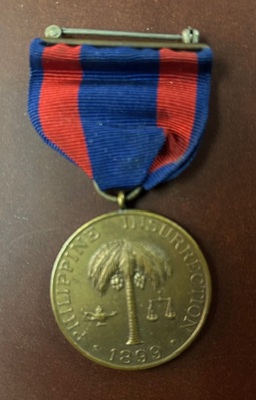
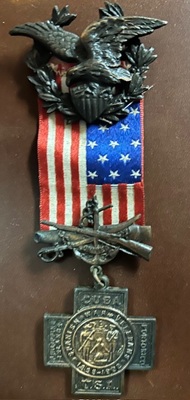
On August 12, 1898, an armistice was reached between the United States
and Spain, ending the war's fighting. The war officially ended with the
signing of the Treaty of Paris on
December 10, 1898. On February 4, 1899 war broke out between the United
States and its former de facto allies, the Filipino forces under Emilio
Aguinaldo. The Philippine-American War had begun. Jennie Edmunds
followed, traveling to the Philippines. She was now listed as officially
being part of the U.S. Army Nursing Corps, not the Red Cross. It is not
clear when she originally shipped out to the Philippines. In November of
1900 she was noted to already be serving in the army transport service,
which ferried troops across the Pacific Ocean to the Philippines. The
cramped conditions aboard the transports was also often unhealthy,
though they were improving. Apparently on returning from one trip she
had reported for service at the San Francisco General Hospital briefly.
She was then ordered to travel to Manila aboard the transport
MEADE (Formerly the transport BERLIN).
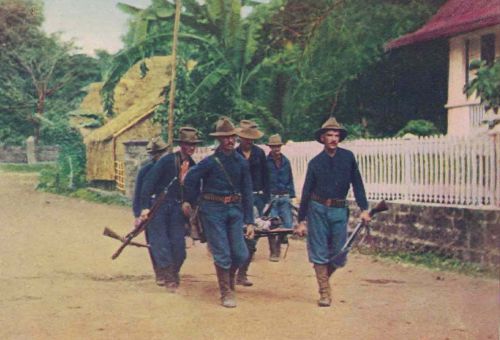
Edmunds served at the Santa Mesa Hospital in Manila treating the wounded and those who had contracted illnesses and disease. The Santa Mesa was a former army barracks in Santa Mesa, a suburb of Manila. The barracks was renovated into a one thousand-bed hospital staffed by ten doctors, twenty-five female nurses four hospital stewards, two acting hospital stewards and one hundred twenty-two Hospital Corp privates.
While in Manila, Jennie Edmunds underwent what must have been a very painful experience. Jennie met a soldier man named Archibald Hutchinson. The two became engaged and married. Jennie apparently left the military service and returned with her husband to the United States. In San Francisco. the truth came out on Mr. Hutchinson's background. Jennie learned that he had been married before and was still married to his first wife. He claimed she had run away with another man, whom he then killed, and seemed surprised that his wife was still alive. Of course, how much of Hutchinson's story was believable is hard to know. Two years later he was arrested also claiming to be Thomas Judson Park, a doctor who graduated fom the University of Georgia. It is unclear which persons he was when he was with Jennie, and is unclear with what military organization he was serving. The marriage to Jennie Edmunds was annulled in 1902.
Jennie Edmunds remained in San Francisco. She was in the area when the 1906 San Francisco earthquake occurred, leveling and burning large swaths of the city. Jennie notified friends in Rochester that she was unscathed and was treating the injured in Berkeley. It seems that she returned briefly to New York state, working as a nurse in the Monroe County Almshouse from April 19 1907 until her resignation on August 18, 1907. For her services she was paid $20 a month.
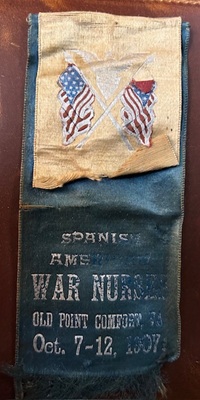
By 1909 Jennie must have moved to Oregon. There she again married, on February 20, 1909 to John Murdo MacLean in Portland. John was about seven years younger than Jennie, and was also from Canada, having been born in Seaforth, Ontario. MacLean had also lived in Creelman, Jennie's home town. Perhaps they knew each other from their youth. It is interesting to note that on the marriage records, Jennie listed this marriage as her first, completely disavowing her annulled marriage to Hutchinson. It is not known how long the marriage lasted, but by 1923, Jennie is listed in the newspaper as Jennie Edmunds, a nurse associated with the Memorial Hospital in Long Beach, California. Also her 1922 application for a government pension based on her service with the Army Hospital Corps refers to her as being formerly Jennie S. MacLean, but apparently now going as Jennie S. Edmunds.
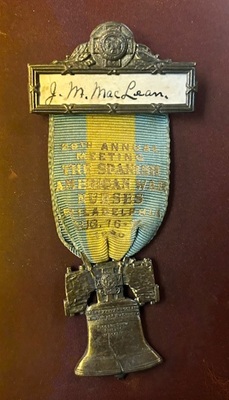
Jennie Edmunds ended her long nursing in 1938, passing away on October 13 of that year. She was buried in the San Francisco National Cemetery. Her government-issued gravestone reads "Jennie S. Edmunds MacLean, New York, Nurse, Army Nurse Corps, October 13, 1938.
Jennie Edmunds was one of the many unsung, and seemingly forgotten heroes, working to save the lives of soldiers and other while putting her own life in danger.
"Another Year of Marked Charity," Democrat and Chronicle (Rochester, New York). January 19, 1899, 12.
"Archibald Hutchinson Again in the Hospital," San Francisco
Chronicle (San Francisco). October 7, 1904, 7.
"Called Before Inquiry Board," San Francisco Chronicle (San
Francisco). November 29, 1900, 12.
"Changes in the Army Nurse Corps Recorded in the Surgeon-General's Office for the Month ending December 12, 1900."
Employment Cards and Peddler's Licenses, New York, 1844 -1 966.
Gillett, Mary C., The Army Medical Department 1865-1917.
(Washington DC: Center for Military History, 1995), 206
Neely's Color Photos of America's New Possessions. (New York:
F. Tennyson Neely, 1899)(Photo of the wounded being carried to Santa
Mesa Hospital, p 30)
Questions for Candidates for Missionary Service, Woman's Baptist Foreign Missionary Society, Boston Massachusetts. Application of Jennie Edmunds. July 24, 1894
Rochester City Directory, 1898
State Marriages, Oregon, 1906-1971
"To Join Clara Barton," Democrat and Chronicle (Rochester, New York). April 25, 1898, 12.
U.S. Civil War Pension Index, General index to pension Files,
1861-1934, National Archives. Application 1473394 for Jennie Edmunds.
"Worker from China Speaker Before Nurses," Press Telegram.
(Long Beach, California). March 4, 1923, 11