1.65 Inch Hotchkiss Mountain Gun
By Doug Howser
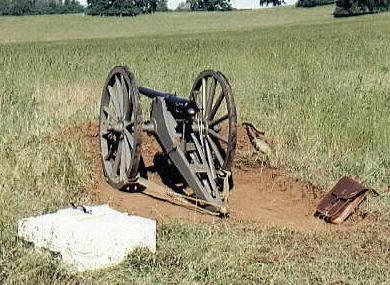
1.65 Inch Hotchkiss Gun (Image courtesy of the
Doug Howser Collection)
Please Visit our Home
Page to learn more about the Spanish American War
GENERAL:
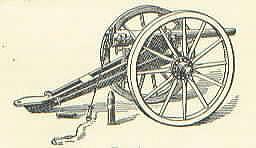
The 1.65 inch Hotchkiss gun a light gun intended to be packed on
mules to accompany either a fast moving cavalry troop or an army
maneuvering in rough country. During the Spanish American War they were
also seeing use as an infantry close support gun. The gun and accessories
could be packed on two mules, with 72 rounds on each ammunition mule.
Packed with the gun was a draught pole and harness so the gun could be
pulled in smooth country.
BACKGROUND:
The 1.65” gun was introduced into federal service as a modern replacement
for the aging 12 Pounder ML Mountain Howitzer. The U.S purchased its first
gun in 1876 from the French arms firm of Hotchkiss Ordnance Co. This gun
was to see combat against the Nez Perce Indians in 1877. Over the next
twenty years the U.S would purchase about fifty-six of these little guns.
In Cuba these guns were fired against Spanish positions at Las
Guasimas by the gun detachment of the 10th U.S. Cavalry where the unit
expended 21 shells. For the attack on San Juan Hill, Lt. Hughes placed
the detachment of four guns 75 yards beyond the San Juan River to shell
the Spanish fortifications. These guns raked the heights as the infantry
attacked. Emplaced on San Juan Hill the 10th U.S. Cavalry's guns helped
repulse the Spanish counterattack on July 2nd. The guns were also
employed during the general bombardment of Santiago on July 10th,
1898.
Later the 1.65” Hotchkiss guns would see combat again in the
Philippine American War
ADVANTAGES/DISADVANTAGES:
The 1.65 Inch Hotchkiss gun was well liked by the troops who used the
gun. Their light weight made them extremely portable. The gun was well
built and simple to operate. It was also a very accurate gun. By the time
of the Philippine American War, the guns were being converted to center
fire cartridge ignition with smokeless powder used as propellant.
The gun did have one glaring deficiency. The projectile was just too
small to employ a time fused shrapnel shell, so there was no way to
air-burst a shell over the enemy. This fault did reduce the gun's
effectiveness.
TECHNOTES:
| Total Weight: |
|
362 pounds |
| Range: |
|
3500 yards (2miles) |
GUN TUBE
| Material: |
|
Steel |
| Total length of tube: |
|
3.83 feet |
| Length of bore: |
|
3.43 feet |
| Travel of projectile: |
|
3.10 feet |
| Calibre: |
|
1.65 inches |
| Weight: |
|
121 pounds |
| Grooves: |
|
10 |
| Twist of Rifling, uniform: |
|
1 in 29.83 cals. |
| Muzzle velocity: |
|
1298 feet per second |
CARRIAGE:
| Material: |
|
Steel |
| Weight, complete: |
|
241 pounds |
| Height of trunion axis above ground: |
|
27.55 inches |
| Diameter of wheels: |
|
37.4 inches |
| Track of carriage: |
|
2.46 feet |
AMMUNITION:
The 1.65” Hotchkiss Mountain Gun fired two types of projectiles. A common
shell, either base fused or nose fused or a canister. The common shell
would explode on contact showering the enemy with jagged shell fragments.
The canister would rip open at the muzzle spraying the enemy with a fan
shaped pattern of hardened lead ½ inch balls. This projectile was used at
close range. The early cartridge case did not have a primer. Instead there
was a hole in the center covered internally with a diaphragm. The gun was
fired by a friction primer inserted into the back of the breech housing.
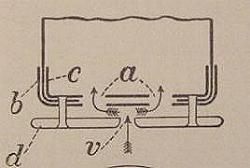
The flame would enter the case head (d) at the center vent (v)
penetrating the case body (a) lifting a diaphragm (not
shown) firing the charge.
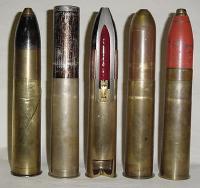
Ammuntion types (l.-r.): Nose fused common shell with early wrapped
case used with friction primer; tin body canister with two piece case
used with friction primer; cut-a-way base fused common with
one piece center fire primered case; brass body canister with center
fire case; late nose fused common shell with center fire case.
| Weight of round (common shell): |
|
2.62 pounds |
| Weight of shell, filled: |
|
1.95 pounds |
| Weight of round (canister) complete): |
|
3.47 pounds |
| Weight of canister: |
|
2.8 pounds |
| Number of balls in canister |
|
30 |
| Powder Charge: |
|
5.5 ounces mortar |
| Bursting charge of shell: |
|
1.8 ounces |
| Weight of cartridge case, empty: |
|
5.3 ounces |
| Weight of fuze: |
|
1.9 ounces |
Dyer, Capt. A.B., Handbook for Light Artillery, (New York:, 1896)
The Hotchkiss Ordnance Company, LTD, Descriptive Catalogue of War
Material, (Factory Catalog, circa 1895)
Cashen, Herschel V. and others, Under Fire with
the Tenth U.S. Cavalry, (Salem, NH, 1969)
Support this Site by
Visiting the Website Store! (help us
defray costs!)
We are providing
the following service for our readers. If you are interested in
books, videos, CD's etc. related to the Spanish American War, simply
type in "Spanish American War" (or whatever you are interested in)
as the keyword and click on "go" to get a list of titles available
through Amazon.com.
Visit Main Page
for copyright data